
Service Design and Technical Architecture: The Twin Pillars of Digital Transformation
This article explores how service design and technical architecture must work hand in hand to drive successful digital transformation. It highlights the pitfalls of treating them as separate disciplines and shows how early collaboration fosters clearer strategy, better user experiences, and fewer costly mistakes.
5/9/20213 min read
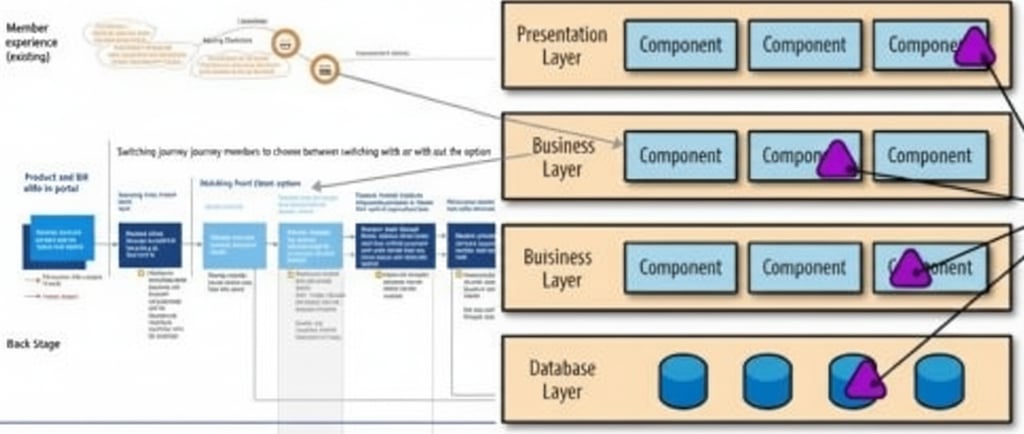
Service design and technical architectures are two strong pillars of digital transformation in an organisation. Service design provides the view of how a service should work for customers and employees whilst delivering business outcomes. Technical architecture provides the underpinning to deliver that service. In my service design experience across a broad range of organisations, I have seen different assumptions taken by the board or the leadership on how and where service design and technical architecture should sit in the planning and delivery roadmap. Rather than being seen as two strands leading to a single goal, they are all too often viewed as separate entities within an organisation. Which one leads and which one follows depends on the risk perception of the business leadership.
Misplaced Priorities in Transformation Planning
Too often, technology is considered the riskier of the two, hence the design of the service comes as an afterthought. Therefore, most of the focus and budget is on planning the technology roadmap and its delivery. Business leaders often assume by virtue of their industry experience, they automatically understand their customers. For many others, the transformation has been so rapid that they have leaped into it without evaluating whether their service is what their end-users really want.
The Tick-Box Culture in Transformation Teams
Transformation teams convincingly employ a tick box exercise to make sure they have completed all relevant tasks for their digital playbook. Often faced with the pressures of time and budget, transformation teams, press ahead with no real effort to understand their users’ needs, wants, and expectations. Hence, in spite of having the best platforms, they struggle to move their target operating model, operating in a traditional manner leaving consumers with an even worse experience than before.
The Tech Mirage: When Tools Replace Understanding
On the tech side, transformation is often presented by vendors as something which has the potential to meet all user needs. When the outcome is not as expected more money is thrown at the project to tackle problems that could have been avoided by adopting a different approach from the outset. Organisations love the experience delivered by the likes of Amazon, Shopify, or other unicorn start-ups, but fail to acknowledge the lengths these organisations go to in order to understand their customers.
A Costly Lesson from Experience
A recent example from one of my past projects is a large financial services organisation when it discovered that its middleware was not fit to scale up add other types of channels and services. The issue, of course, lay in the early stages of development. Service design and technology architecture teams did not sit down together to discuss what they were trying to achieve. This prevented them from working towards an agreed goal that delivered for the company and consumers alike. By the time the problem was realized, it was too late to adopt service design recommendations as it impacted the promised transformation roadmap to the board.
Beyond Going Digital: Designing for Micro-Experiences
In today’s micro-experience-driven hyper-connected consumer era, even the best brands will struggle to compete if they have a sub-par service. Customers view the organisation as a single entity, not a number of different departments. Becoming digital is not enough, stitching the experience into digital is crucial to success. The solution is to look at the overall failure demand from the system rather than creating a short-term problem fix.
The Shift Toward Holistic Collaboration
Fortunately, more and more C-level leaders are adopting a more holistic approach to service design and technical architecture. They are realising the benefits of bringing different departments together to talk about their future offering. The focus is more on understanding the problem than finding a problem for a tech solution. Customer-centricity and employee-centricity has become an integral part of initial discussions. It doesn’t matter that the tech team doesn’t know anything about service design or that the service design team has no idea about how tech works. What matters is that the service designers are allowed to challenge and hear from the tech team whether their ideas can be realised. All strands of the company know where they are headed and what they need to do to get there.
Building Shared Vision and Preventing Problems Early
With this comes a clear strategy and vision. Future planning is more comprehensive and risk assessments are more accurate. It is no longer necessary to wait until a problem presents itself and then spend time, effort, and money working out how to tackle it. Many problems can be avoided simply through early dialogue. There will, of course, still be problems that occur during development. But they are far fewer when all sides are working together. And when they do arise, everybody involved in the project understands what the goal is.
©2023 Strated, All rights reserved
CONTACT
5 Brayford Square
London
E1 0SG
United Kingdom